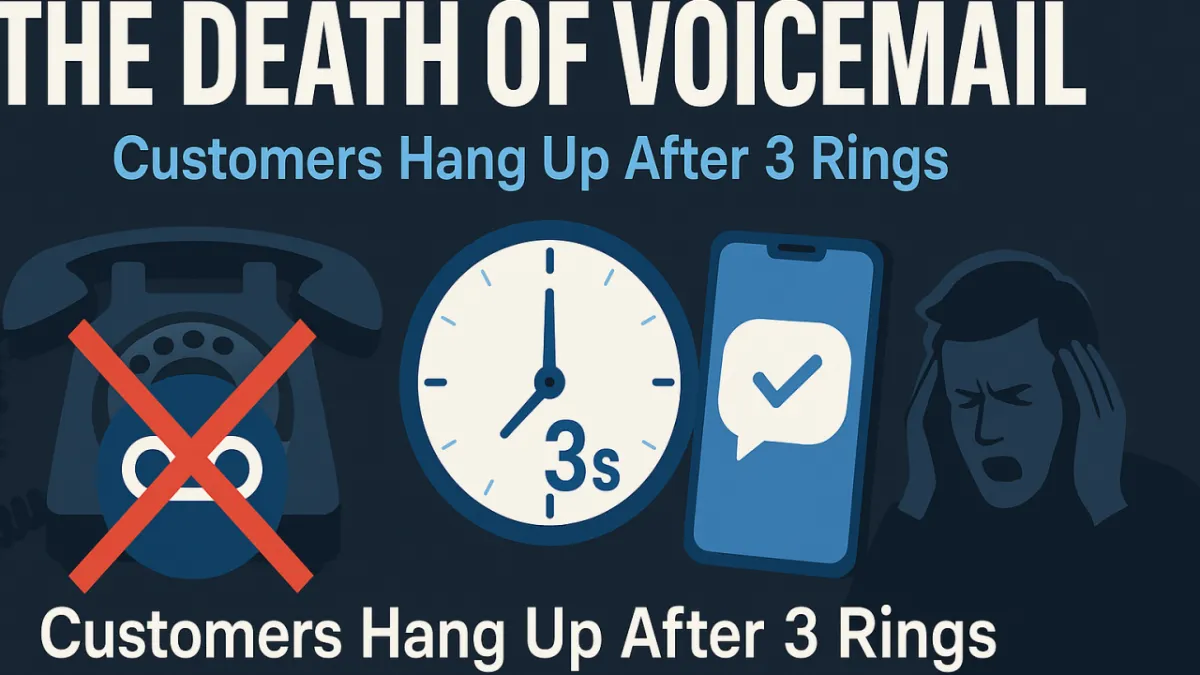
The Death of Voicemail: Why Customers Hang Up After 3 Rings
The phone rings once. Twice. Three times. Click. Dial tone.
In the time it took you to read that sentence, your business just lost a potential customer. They didn’t wait for voicemail. They didn’t leave a message. They simply hung up and called your competitor.
This scenario plays out thousands of times every day across the UK, and most business owners have no idea it’s happening.
Welcome to the death of voicemail — a fundamental shift in customer behaviour that’s quietly devastating small businesses while they cling to communication methods that worked twenty years ago but fail catastrophically today.
I discovered this harsh reality while analysing call patterns for a heating engineer. Mark had invested in a professional voicemail system, complete with a polished greeting explaining his services and promising to return calls within four hours. He was proud of his professional approach and couldn’t understand why his phone seemed to ring less frequently than his competitors, despite having better reviews and more experience.
The truth was brutal. Mark’s phone wasn’t ringing less — customers were hanging up before his voicemail greeting even started. In a week-long analysis, we discovered that 68% of callers disconnected within the first three rings. Of those who heard his voicemail greeting, only 22% left messages. Mark was losing nearly 80% of his potential customers before any meaningful interaction occurred.
Mark’s experience isn’t unique. It’s the new normal in a world where customer expectations have been fundamentally reshaped by instant gratification technology.
The Psychology of Modern Customer Expectations
To understand why voicemail has become a business killer, we need to understand how customer psychology has evolved in the digital age. Modern consumers have been conditioned by Amazon’s one-click ordering, Uber’s instant ride requests, and Netflix’s immediate entertainment access. They expect immediate response, instant gratification, and seamless interaction with every business they encounter.
This conditioning runs deeper than mere impatience. It’s created a fundamental shift in how customers interpret business responsiveness. When a phone rings without immediate answer, modern customers don’t think “they must be busy with other customers.” They think “this business doesn’t prioritise customer service” or “they’re probably too small to handle my needs properly.”
The three-ring threshold isn’t arbitrary — it’s psychological. Research shows that customer anxiety begins increasing after the second ring. By the third, many have already decided the business is unresponsive. By the fourth, most have mentally moved on to their next option.
This is especially true for younger customers who never lived in a world where waiting for callbacks was normal. For millennials and Gen Z, it’s not just that businesses should respond quickly — they must respond immediately. A voicemail greeting feels outdated, unprofessional, and out of touch.
Unanswered calls also create long-term emotional damage. Even if the business calls back, the customer may already feel let down — more likely to doubt pricing, question service, and choose someone else next time.
The Voicemail Illusion
Many business owners operate under what I call the voicemail illusion — the belief that a polished voicemail system provides adequate service. It doesn’t. It provides false reassurance while customers slip away unnoticed.
This illusion is built on outdated assumptions: that customers will wait, that professional greetings create positive impressions, and that message-taking is good enough. None of those are true today.
Imagine a customer journey: the caller has an urgent issue. The phone rings four times. Voicemail picks up. They hear a long greeting. They leave a message. Then they wait — while competitors are answering instantly. Even if the business calls back, it’s too late. The customer has already moved on.
That polished greeting becomes a liability. People don’t want to hear about your twenty years of experience. They want to talk to someone now.
The Competitive Disadvantage
In competitive markets, voicemail is not just a nuisance — it’s a serious disadvantage. While you’re hoping customers leave messages, your competitors are picking up instantly.
This compounds over time. Customers who get fast responses become loyal, leave glowing reviews, refer friends, and return again. Meanwhile, your business never gets the chance to impress them at all.
Worse, you get negative reviews like “hard to reach” or “never answered.” These don’t just harm your reputation — they kill your visibility in search results. Google favours businesses with strong engagement. Slow responders fade into the background.
The Emergency Service Catastrophe
If you’re in emergency services — plumbing, electrics, heating — voicemail is catastrophic. These are the highest-value calls: emergencies worth hundreds of pounds. They’re also the most time-sensitive.
When a boiler breaks or a pipe bursts, people don’t wait for callbacks. They ring three or four companies at once. The first one to answer wins the job — and likely the customer for life.
Miss that call, and you miss the job, the follow-up work, the referrals, the reviews — the lifetime value.
Even if you eventually return the call, you’re too late. The customer remembers the stress and frustration, not the good work that came later.
The Social Media Effect
Unanswered calls don’t just cost you that one job — they cost you your reputation. Today, frustration becomes public. One bad experience gets posted on Facebook or a local forum: “Tried calling, couldn’t get through — anyone know someone more responsive?”
Now your reputation is damaged, and your competitor just got a free endorsement.
The reverse is also true. Businesses that respond immediately often get glowing mentions online: “They answered straight away,” “Came out within the hour.” That kind of praise spreads quickly and builds your brand.
The Technology Solution
Voicemail isn’t being replaced by silence — it’s being replaced by smart, real-time technology. AI-powered call answering offers immediate response with natural conversation. It greets callers, answers questions, books appointments, assesses urgency, and provides guidance.
Unlike voicemail, it keeps the conversation going. It doesn’t force customers to wait or hang up.
These systems are tailored to each business and can distinguish between urgent and non-urgent requests. They sync with your calendar, notify you when needed, and integrate with your phone system.
Setup is fast. Costs are predictable. And the return on investment is immediate.
The Competitive Advantage
When every call is answered instantly, you don’t just win the job — you win customer trust. That translates into repeat business, referrals, and five-star reviews.
Your stress goes down, your revenue goes up, and your reputation improves — both online and off.
The Future of Communication
Voicemail isn’t evolving — it’s vanishing. Customers have already changed. Businesses that change with them will thrive. Those that don’t will be left behind.
Mark, the heating engineer I mentioned earlier, switched to AI call answering. In just eight months:
• His customer capture rate rose from 22% to 96%
• His revenue jumped by 41%
• His stress dropped significantly
He no longer fears missing calls. His customers are happier. And his business is growing.
Voicemail isn’t a safety net. It’s a leak in your pipeline.
The choice is simple: evolve or become extinct.
Your customers have already decided.
The only question is — have you?
⸻
Bryan Himsworth
Founder, EmpowerAi Solutions
📞 01473 973664
