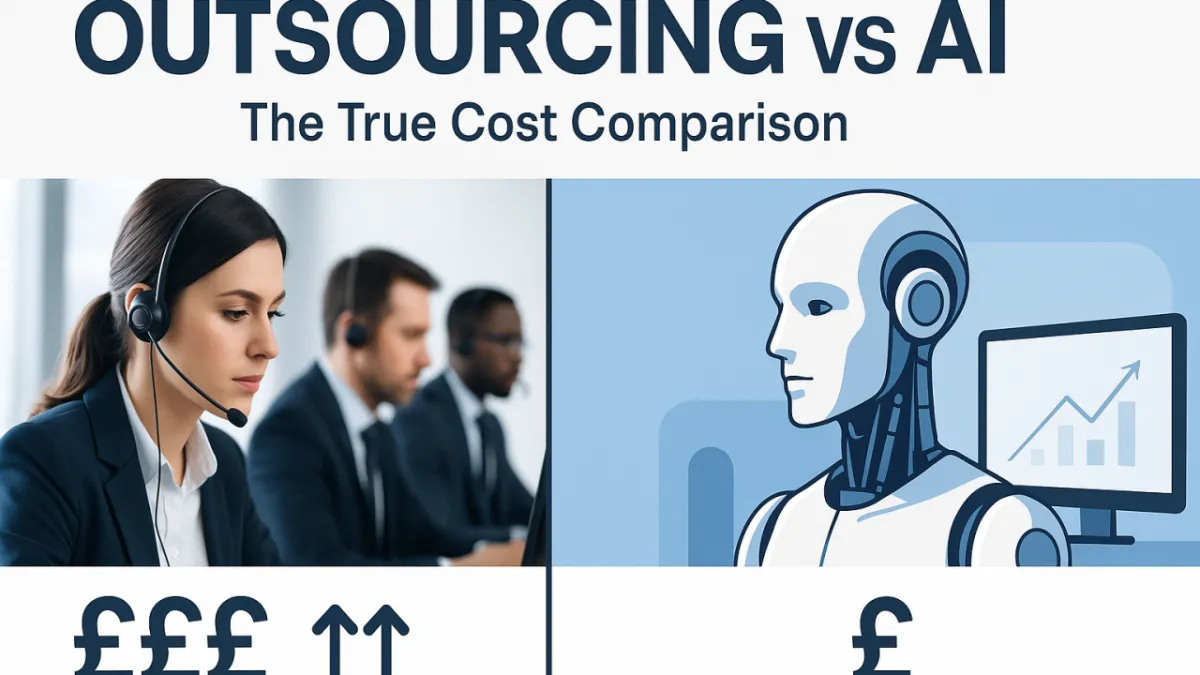
Outsourcing vs AI: The True Cost Comparison for Small Businesses
When James, a successful plumbing contractor in Cambridge, decided he needed help managing his growing call volume, he did what most business owners do: he started researching traditional solutions. Call answering services quoted him £800-£1,200 per month. Hiring a part-time receptionist would cost £15,000-£20,000 annually plus benefits, training, and management overhead. A full-time employee would double those costs.
The quotes seemed reasonable for professional call handling, so James signed up with a well-regarded answering service. Six months later, he was frustrated, losing customers, and seriously considering canceling the service. The hidden costs, unexpected limitations, and poor customer experience had turned his solution into a new problem.
James's experience illustrates a critical issue facing small businesses today: the true cost of traditional outsourcing solutions extends far beyond the monthly fees. When business owners compare outsourcing to AI solutions, they often focus on the obvious costs while ignoring the hidden expenses that can make traditional solutions more expensive and less effective than they appear.
Understanding the complete cost picture is essential for making informed decisions about business communication solutions. The cheapest option upfront is rarely the most cost-effective long-term solution.
The Hidden Costs of Traditional Call Answering Services
Traditional call answering services operate on business models that create numerous hidden costs and limitations that aren't apparent during the sales process. These hidden costs often double or triple the effective cost of the service while reducing its value to the business.
The most significant hidden cost is the per-call pricing structure used by most answering services. While they advertise monthly rates, these rates typically include only a limited number of calls - often 50-100 per month. Additional calls are charged at rates ranging from £2-£5 each. For growing businesses, these overage charges can quickly exceed the base monthly fee.
James discovered this reality when his monthly bill jumped from £800 to £1,400 during a busy period. The answering service had handled 180 calls instead of the 100 included in his plan, generating £800 in overage charges. When he complained, they explained that busy businesses typically need higher-tier plans costing £1,500-£2,000 monthly.
The quality control costs are equally hidden but more damaging. Traditional answering services use generic scripts and operators who lack industry knowledge. They can't assess emergency situations, provide technical guidance, or represent the business with the expertise customers expect. This leads to frustrated customers, missed opportunities, and damaged reputation.
Training costs represent another hidden expense. Answering service operators require ongoing training about the business, its services, pricing, and procedures. This training is typically charged separately and must be repeated as operator turnover occurs. Many services experience 40-60% annual turnover, requiring constant retraining at the business owner's expense.
Integration costs are often overlooked during the sales process. Most answering services use separate systems for message taking, appointment scheduling, and customer management. Integrating these systems with existing business operations requires additional software, setup fees, and ongoing maintenance costs.
The opportunity cost of poor service quality is perhaps the most expensive hidden cost. When answering service operators provide generic, uninformed responses to customer inquiries, potential customers often choose competitors who demonstrate better knowledge and professionalism. This lost revenue is difficult to quantify but can easily exceed the cost of the service itself.
The True Cost of Human Employees
Hiring employees to handle calls appears straightforward but involves numerous costs that business owners often underestimate. The salary is just the beginning of a complex cost structure that can make employee-based solutions surprisingly expensive for small businesses.
A part-time receptionist earning £10 per hour for 20 hours weekly costs £10,400 annually in wages. However, the true cost includes National Insurance contributions (13.8%), pension contributions (minimum 3%), holiday pay (12.07%), and sick pay provisions. These mandatory costs increase the effective hourly rate to approximately £13.50, raising the annual cost to £14,040.
Training costs for new employees are substantial and ongoing. A receptionist needs to learn the business's services, pricing, procedures, customer management systems, and industry-specific knowledge. Initial training typically requires 40-80 hours of the business owner's time, representing £1,000-£2,000 in opportunity cost. Ongoing training and supervision add additional costs throughout the employment relationship.
Equipment and workspace costs are often overlooked. Employees need desks, computers, phones, software licenses, and workspace. For a small business, providing appropriate workspace and equipment for a receptionist can cost £2,000-£5,000 initially, plus ongoing maintenance and upgrade costs.
Management overhead represents a significant hidden cost. Employees require supervision, performance management, scheduling coordination, and administrative support. For small business owners, this management responsibility takes time away from revenue-generating activities and core business operations.
Turnover costs can be devastating for small businesses. When a receptionist leaves, the business faces recruitment costs, training costs for the replacement, and productivity losses during the transition. Industry data shows that replacing a receptionist typically costs 50-75% of their annual salary when all factors are considered.
Coverage gaps create additional costs and risks. Human employees take holidays, call in sick, and occasionally quit without notice. During these periods, the business either loses call coverage or must arrange expensive temporary coverage. For small businesses, these gaps can result in missed opportunities and frustrated customers.
When all costs are considered, a part-time receptionist typically costs £20,000-£25,000 annually, while a full-time employee costs £35,000-£45,000. These figures don't include the opportunity costs of management time or the risks associated with employment law compliance.
The AI Alternative: Transparent Pricing
AI call answering solutions operate on fundamentally different cost structures that eliminate most hidden costs while providing superior service quality. Understanding these differences is crucial for accurate cost comparisons.
AI systems typically use flat-rate pricing that includes unlimited calls, eliminating the overage charges that plague traditional answering services. A business experiencing growth doesn't face escalating costs as call volume increases. The monthly cost remains predictable regardless of business success.
Setup and training costs for AI systems are typically included in the service fee or charged as one-time costs rather than ongoing expenses. Once configured, AI systems don't require retraining due to turnover or ongoing education about business changes. Updates and improvements happen automatically without additional charges.
Integration costs are minimal because modern AI systems are designed to work with existing business tools and processes. They can integrate with existing calendars, customer databases, and communication systems without requiring expensive custom development or ongoing maintenance.
The quality consistency of AI systems eliminates the reputation risks associated with human operators. AI systems provide consistent, professional responses based on the business's specific requirements. They don't have bad days, personal problems, or knowledge gaps that affect customer interactions.
Coverage is complete and automatic. AI systems don't take holidays, call in sick, or quit unexpectedly. They provide 24/7 availability without additional costs or coverage arrangements. This reliability eliminates the stress and costs associated with maintaining consistent customer service coverage.
For most small businesses, comprehensive AI call answering costs £3,000-£6,000 annually - significantly less than human employees or traditional answering services when all costs are considered.
Performance Comparison
Beyond cost considerations, the performance differences between traditional solutions and AI systems are substantial and measurable. These performance differences directly impact business revenue and customer satisfaction.
Call handling capacity represents a major performance advantage for AI systems. Traditional answering services often experience delays during busy periods, with customers waiting on hold or calls going to voicemail. Human employees can handle only one call at a time, creating bottlenecks during peak periods. AI systems can handle multiple calls simultaneously without delays or quality degradation.
Response consistency is another significant advantage. Human operators have varying knowledge levels, communication skills, and energy levels that affect customer interactions. AI systems provide consistent, professional responses regardless of call volume, time of day, or external factors.
Industry knowledge and expertise represent crucial performance factors. Traditional answering services use generic operators who lack specific industry knowledge. AI systems can be trained with comprehensive industry expertise, allowing them to provide informed responses and assess situations accurately.
Emergency handling capabilities vary dramatically between solutions. Traditional answering services typically take messages for emergency calls, creating dangerous delays in urgent situations. AI systems can assess emergency situations immediately and dispatch appropriate help while providing safety guidance to customers.
Appointment scheduling and customer management integration work seamlessly with AI systems but often require manual processes with traditional solutions. AI systems can check availability, schedule appointments, and update customer records automatically, while human operators typically require separate systems and manual data entry.
Long-term Value Considerations
The long-term value proposition of different solutions becomes more apparent over time as businesses experience the cumulative effects of their choices. Initial cost savings from cheaper solutions often disappear as hidden costs accumulate and performance limitations impact business growth.
Scalability represents a crucial long-term consideration. Traditional answering services become more expensive as businesses grow and call volumes increase. Human employees require additional hiring and management as businesses expand. AI systems scale automatically without proportional cost increases, making them more cost-effective as businesses grow.
Technology advancement benefits AI users automatically while traditional solutions remain static. AI systems continuously improve through software updates and enhanced capabilities, providing increasing value over time. Traditional solutions maintain the same limitations and capabilities regardless of technological progress.
Customer satisfaction improvements from AI systems compound over time through better reviews, increased referrals, and stronger customer relationships. Traditional solutions often create customer satisfaction challenges that damage long-term business prospects.
Competitive advantage from superior customer service becomes more valuable as markets become more competitive. Businesses using AI systems can provide service levels that traditional solutions can't match, creating sustainable competitive advantages.
Real-World Case Studies
James, the plumbing contractor mentioned earlier, eventually switched from his traditional answering service to an AI system. The cost comparison was dramatic: his answering service was costing £1,400-£1,800 monthly with overage charges, while the AI system cost £350 monthly with unlimited calls.
More importantly, the performance improvement was immediate and measurable. Customer complaints about poor service disappeared. Emergency calls received immediate, professional response. Appointment scheduling became automatic and accurate. James's customer satisfaction scores improved significantly, leading to more referrals and repeat business.
A heating engineer in Suffolk compared the costs of hiring a part-time receptionist versus implementing an AI system. The receptionist would have cost approximately £22,000 annually including all employment costs. The AI system cost £4,200 annually while providing superior coverage and capabilities. The cost savings allowed him to invest in additional equipment and marketing that grew his business significantly.
An electrical contractor tried three different solutions over two years: a traditional answering service, a part-time employee, and finally an AI system. The answering service cost £15,600 annually but provided poor customer service. The part-time employee cost £24,000 annually but created coverage gaps and management overhead. The AI system cost £5,400 annually while providing better service than either previous solution.
Making the Right Choice
Choosing the right call handling solution requires understanding the complete cost picture and long-term implications of each option. The cheapest upfront cost rarely represents the best long-term value.
Traditional answering services might seem cost-effective initially but often become expensive and problematic as businesses grow. The hidden costs, quality limitations, and scalability issues make them poor long-term solutions for most businesses.
Human employees provide personal service but involve significant costs, management overhead, and reliability risks that many small businesses can't afford or manage effectively.
AI systems require higher upfront investment in some cases but provide superior long-term value through transparent pricing, consistent performance, and automatic scalability.
The decision should be based on total cost of ownership, performance requirements, and long-term business goals rather than initial price comparisons.
The Future of Business Communication
The communication landscape is evolving rapidly as customer expectations increase and technology provides new capabilities. Businesses that choose solutions based on outdated assumptions about cost and performance will find themselves at competitive disadvantages.
AI technology will continue improving while becoming more affordable, making the value proposition even more compelling over time. Traditional solutions will struggle to compete with AI capabilities and cost structures.
Customer expectations for immediate, professional response will continue increasing, making superior communication capabilities more important for business success.
James's plumbing business has thrived since switching to AI call handling. His costs decreased by 75% while his customer service quality improved dramatically. He captures more opportunities, satisfies more customers, and operates more efficiently than ever before.
The choice between traditional outsourcing and AI isn't just about cost - it's about the future of your business. The businesses that recognize this reality and choose accordingly will have significant advantages over those that cling to outdated solutions.
The true cost comparison isn't just about monthly fees. It's about the total impact on your business success, customer satisfaction, and long-term growth potential. When viewed from this perspective, the choice becomes clear.
---
Bryan Himsworth is the founder of EmpowerAI Solutions, helping businesses understand the true costs and benefits of different communication solutions. For a detailed cost comparison specific to your business, visit www.empoweraisolutions.co.uk or call 01473 973664.
